
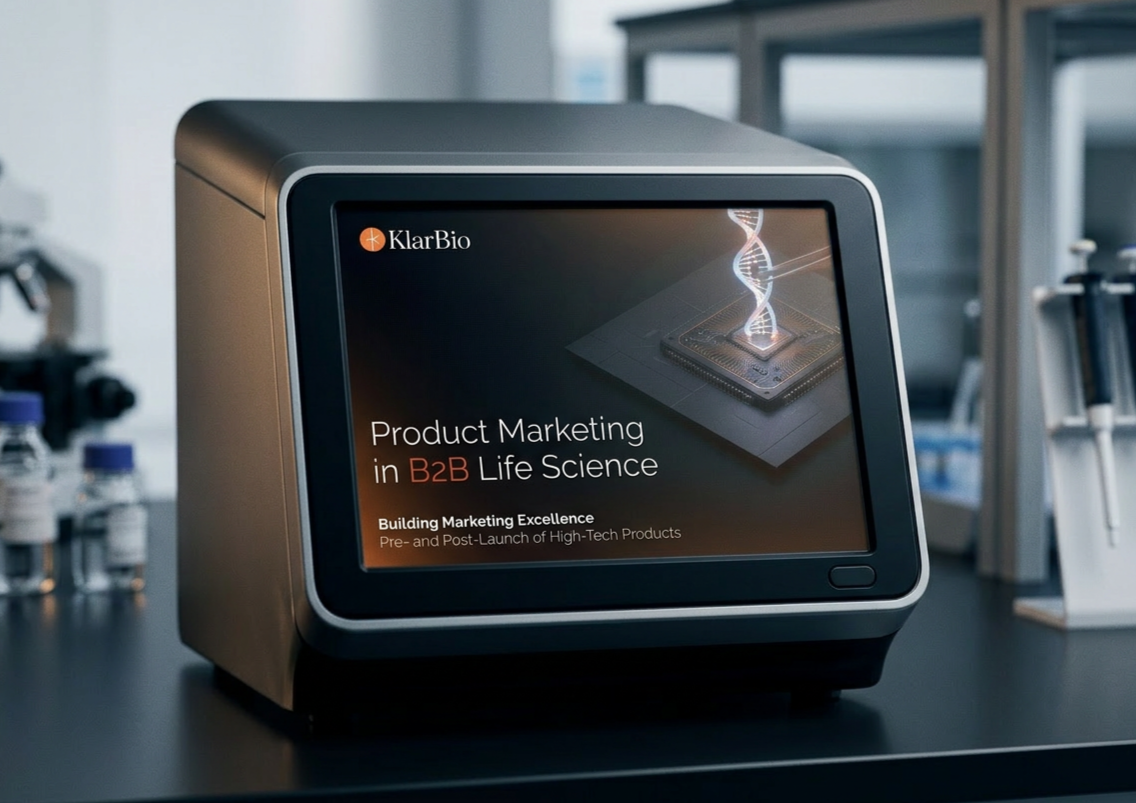
This is the playbook for product marketing in life science.
It’s the missing function
Product marketing is the lever by which high-tech products gain market adoption. This playbook contains insights from working with several B2B life science companies, from pre-revenue to those doing €1 billion annually.
What’s inside:
Timeless marketing fundamentals AI does not change
The cost of misalignment in marketing and sales
Why most “marketing” is not marketing
Assessing the gaps in your organization
The step-by-step approach I use at KlarBio to connect strategy to marketing tactics that attract customers
General information-
The difference is in the word “product," as strategic marketing can be applied to not-for-profit entities and other companies that do not sell products or services. In some roles, strategic marketing refers to tasks found more upstream of product marketing roles. However there is a great deal of overlap. I believe product marketing starts before a product is developed; however, product marketing roles at tech companies typically involve preparing for a product launch or improving the overall success of launched products. Product marketing however in those firms would contribute to shaping the roadmap.
-
Product marketing is found at all big tech companies. But why life science? The notion of product marketing applies to any company struggling to occupy the position in the market they are convinced their product can occupy. Life science companies that benefit are those selling products that take only a few years to develop, as compared to a small molecular which may take a decade. Product marketing is therefore useful for companies selling a physical or digital product, or a productized service, to other companies, and require their business to stay afloat. The pharmaceutical company on the other hand has an entirely different business model and product marketing may have a different name, such as competitive intelligence, innovation, strategy, etc. One of the central challenges product marketing solves for B2B life science companies is explaining a complicated solution in terms that resonate with customers and get them to more quickly understand if it’s worth investigating or not, i.e., messaging. Everyone struggles with messaging, myself included. It’s especially challenging the more technical the product gets.
-
I have a BSc in kinesiology and neuroscience from the University of Maryland, College Park and a MSc in integrative medicine research from the National University of Natural Medicine. I have a certification in marketing strategy from IMD. I have worked with 17 life science companies both as an employee and as a consultant to improve communication and marketing. My most recent full-time role was as a product marketing manager at a company offering a platform for multiomic data analysis. Before embarking on a career in marketing, I enjoyed writing scientific blogs as a hobby and learning how to build websites. These early efforts helped me understand how to move people to take action with online communications. Beyond marketing, I have had sales training in the insurance and personal training industry, and now in life science services. These experiences shape my commercial focus.
-
As explained in this playbook, KlarBio employs a 4-phased method to address the strategic marketing gaps in your organization and prescribe a tactical plan that is based on your company’s needs. KlarBio is not a market research firm, nor an advertising agency, but we do offer help with ads. As a product marketing company, we run workshops that clarify product strategy and get better results with hands-on execution that is directly connected to the strategic work. For example, before writing SEO articles, we develop an understanding of what customers are interested in by listening to them. Before we do that we understand which markets the company wishes to target for the next few quarters. Another key element of KlarBio’s services is sales enablement, which includes templates and repeatable processes for providing your sales team with a better understanding of what to say in each situation.