Common Challenges in Marketing Life Science Tools
Life science tools companies are sales-led organizations, where marketing is expected to hand over leads. This assumption creates many limitations in commercializing products and services in this market. In this article we will define what marketing excellence looks like and how to get more out of a marketing team.
Companies selling tools in the life science market, including reagents, instruments, software, kits, assays, and now AI tools for drug discovery, development, or commercialization depend on customer-facing employees to grow. Currently, marketing is perceived as a promotional function, and marketing leaders tend to control mostly how products are promoted.
But marketing involves 3 other P’s: product, place, and price, which marketing also influences—those with these responsibilities tend to fall outside the typical marketing department.
The companies that succeed in life science tools, like Sartorius, Bio-Techne, Miltenyi Biotec, Zeiss, Genovis, Cell Signaling Technologies, Twist Biosciences, Qiagen, and Thermo Fisher to name a few, demonstrate marketing maturity and continue to satisfy customers. I had the pleasure of working at Miltenyi Biotec early on in my career, and remember attending a cross-functional meeting once, with every marketing and communications team was in the meeting, from corporate communications to brand to marketing communications.
They made it clear that companies that invest more in their brand see more profits, citing a report from Mercedes-Benz. I noted how passionate they were about the value of brand, from the way the logo looked to the way they appear at conferences. I hope that one day, we can cite marketing research specific to our industry as well.
Why Marketing is Different in Life Science
Marketing in this space isn’t like all B2B marketing. First of all, it’s tech and science we are marketing at the same time. Buyers need detailed information and they need to make careful decisions over several months of testing and validating. Tech marketing in general can vary tremendously. So can “life science marketing” which is so broad of a term it has little meaning (can be B2B, B2C, B2B2C, B2G, etc.).
Here, we are trying to increase the sales of products sold to customers in varying verticals, including, but not limited to, the pharmaceutical and biotechnology companies, contract research and manufacturing organizations, governmental entities, academic institutions, teaching hospitals, hospitals and medical clinics, veterinarians, agriculture companies, and cosmetics manufacturers.
Marketing these types of products can feel slow, challenging, and as if what works in other industries doesn’t apply to life science. For example if you invest €100k on advertisements, when can you expect to see a return? For a consumer software product, you would expect it quickly. It can vary in life science, but it is possible to see predictable returns.
That being said, there are indeed common challenges in bringing life science tools to market that apply to many others and which I have seen repeatedly. There are others that are more commonly found in life science and that’s why I wrote this article. Maybe some of them will apply to your organization, so let’s take a closer look.
Challenge #1: Talking too much about the product
Innovation is exciting, and it’s natural that after spending years developing a groundbreaking product, you want to talk about it. But when this is the only focus of marketing communications, you limit who you reach.
The most common symptom is a feature-heavy brochure. The cure is to focus on the customer’s problems using a framework like jobs-to-be-done (JBTD). The customer need, problem, and pain points need to relate to the features, benefits, and value of the solution.
For example, if you have a product that improves drug discovery in some way, you can talk about the impact of making better medicines on humanity, e.g., drugs produced faster and at a lower cost could enter ROW markets more quickly, lowering disease burden in countries with worse access to healthcare. Put your product in the context of the larger story.
Key terms
-
The process of collaborating between product development, downstream marketing, sales, and the CEO, with the aim of a product or productized service to reliably gain market share or maintain its standing in a defined segment by better serving the needs of its customers and better communicating value o both external audiences and sales teams.
-
The steps that precede promotional marketing activities (downstream), such as identifying a product or service’s target market and ideal customers, developing a clear understanding of use cases that solve customer problems, and developing a go-to-market strategy.
Read: Upstream Marketing by Tim Koelzer and Kristin Kurth -
Promotional activities and advertising, which most people mistakenly call “marketing” due to the highly promotional nature of most marketing departments. Includes activities like:
Attending scientific congresses
Designing graphics and logos
Creating a website and writing web pages
Visualizing your offering with video
Using advertising on platforms like Meta, Google, LinkedIn, Reddit, ChatGPT or the like to reach your audience
Maintaining an email newsletter
Writing LinkedIn posts
-
Developing an understanding of what it will take to bring a product to market and keep it there. It’s a plan a strategy and alignment in deploying the plan on time. It happens before commercialization and after and stops once you achieve product-market-fit.
It’s what I help companies with the most, as explained in my playbook on product marketing. -
Companies have this when they repeatedly demonstrate the ability to quickly test strategies to generate more sales and satisfy customers. An example would be launching a new feature in a software product because customers requested it, and turning this launch into a campaign to attract new customers.
Challenge #2: Ignoring Commercialization or Market Access While Building
It does take several years to develop a great product that can be sold to scientists, doctors, or pharmaceutical companies. However, gaining traction after spending years developing it requires a very different mindset compared to that required to create the product. Why not invest some time before you enter a commercialization phase to consider your target markets, customers, and who the competition really is?
Lesson: The quality of the product doesn’t suddenly transform the company’s income.
For diagnostic and HealthTech products, the roadmap to market access must be understood before the commercialization roadmap starts to materialize. I have spoken to CEOs at startups that are under immense pressure to turn things around when little is understood about the product’s strategy.
The playbook is nothing new: identify the markets and regulatory pathways that can enable the success of the product. Yet, the challenges here involve many non-technical details:
Getting internal stakeholders to understand who to target
Being willing to make bets
Saying no to some markets
Sticking to a plan to test and learn
The biggest risk here is running out of cash before the product gains traction. In pharmaceutical manufacturing, it’s important to start preparing for GMP manufacturing early, and it’s important in the tools market to start defining the sales and marketing infrastructure you need earlier rather than later.
Challenge #3: Ad-hoc, Piecemeal Promotion
A marketing campaign here, an email campaign there, events every other week that don’t generate leads. Piecemeal promotion is the status quo and a downstream consequence of misalignment across leadership. It feels reactive and desperate and doesn’t bring out your team’s best work.
This challenge I have experienced firsthand originates in one’s mindset, not in one’s budget. For a pre-seed startup, piecemeal activities make sense. But once you are ready to launch, there should be a regular cadence at the pace you can afford to maintain.
I’ve experienced this as a marketing specialist and thought to myself how this problem occurs. Is it because the marketing team (and leader) doesn’t completely understand the business and science behind the company’s offerings? Is it because there is a labor shortage?
The reason I believe it happens is because the overall strategy for the product isn’t translated into a tactical go-to-market effort that everybody understands. People do things separately in their respective teams, not communicating with each other. But translating the strategy into a concrete marketing plan is a monumental effort. There are so many trends and changes taking place all the time that also force us to pivot in the middle of things.
So the best way to prevent marketing from becoming completely reactive and uncoordinated is to have insight into what’s working already, and advocating for doing the things that work more and doing the things that don’t work, less.
Challenge #4: Measuring Results
Scientists predict protein binding affinity, monitor cell culture conditions, analyze the presence of biomarker in tissue samples, but what are marketers measuring?
Without measuring accurately and consistently what actually matters to your business, there is no point in investing in marketing. Sales is easy to measure. Marketing has always been complex, but you can measure either lagging or leading indicators.
Leading indicators include things like page views, the number of leads and demos you are booking, and other indicators that help us determine that things are on the right track.
Lagging indicators would be performance metrics that take more time to show up. This could include a number of KPIs, like churn rate, customer acquisition costs, asset turnover ratio, EBIT or EBITDA, or the lifetime value of a customer.
There are three musketeers of marketing at KlarBio. The first is strategy, the second is implementing the strategy, and the third is measurement. Marketing strategy without measurement is like building a supercar that accelerates down a landing strip expecting to take off, yet driving into the ocean instead. You measured the angle at take off, for something that never was going toThe purpose of investing in marketing is to increase the number of customers. Yet, too many companies don’t know if their marketing team is making a measurable difference there. That being said, marketing as a discipline extends beyond the traditional marketing team. Most “marketing” teams are doing advertising, which is only one aspect of marketing.
To accurately assess the performance of your marketing team, do this:
Calculate your cost of customer acquision (CAC)
Marketing and sales spend and salaries / number of new customers over a quarter
From there, understand how many closed/won deals came from leads generated by marketing
Repeat for leads sourced by sales
Recalculate CAC for marketing and sales-generated leads each
If there is a large disrepancy, then you can find the weak link and aim to bolster it.
If the CAC from marketing-sourced leads is especially high, it’s important to consider if the messaging on the website is resonating with readers. The majority of the buyer journey takes place before the buyer speaks to a sales rep.
Challenge #5: CMOs and Marketing Teams Without Science or Engineering Backgrounds
Your marketing leader, whether it be a head of marketing or a Chief Marketing Officer, can’t do their job without understanding the basic technicalities behind your technology and product, as well as the technicalities behind the customer experience. Can they even use the product? If you sell specialized services, could they explain it to a customer?
Too often, a CMO becomes a ‘1P’ CMO, a term Steve Patti—who has held the CMO title 7 times—coined. There are 4 P’s to marketing: product, price, place, and promotion. 1P CMOs only influence promotion. These are CMOs who can’t talk about the product or influence strategy. Neither does their team.
And these CMOs don’t usually understand the company. I’ve been the specialist and mid-level manager who the 1P marketing team needed to approve messaging and translate technical jargon from other teams. But it shouldn’t be this way.
Marketing’s purpose isn’t just to generate leads, but also to shape the way the company delivers value. That mindset shift leads to different hiring choices, and having someone with a scientific background is essential, unless they can also understand the business and the science easily.
Mindset Differences
Scientists are trained to uncover facts by questioning and testing. Engineers are too, but with an added incentive to build something tangible and move much faster than the typical scientist. Different worlds and cultures, but both are more analytical than the average person. They are trained to question their biases, even though no one does it perfectly.
Marketers on the other hand tend to be creative, more in tune with human psychology, and aren’t always as analytical, although some marketing roles require that too, like those involving data analytics, or search engine optimization. They are rewarded for moving people and inspiring them to take action.
It’s generally easier to train someone with a relevant engineering or scientific background in marketing than the other way around.
What tends to happen when marketing teams lack a STEM background (science, technology, engineering, and mathematics), is that they get siloed fast. I’m not suggesting that ever marketing hire needs to have a scientific background as that doesn’t make sense either for some roles. People with scientific background can struggle to be creative and move quickly with agility.
But marketers of all backgrounds should be included in discussions about the business and the product. That’s the only way to learn.
That’s why having a product marketing mindset isn’t enough. There needs to be a cultural shift that unites people around the central purpose of the business. The book Agile Marketing by Neil Perkin talks about this.
Challenge #6: Marketing Fights Battles With Sales and Product
I cannot state this enough: misaligned teams are costing B2B companies. There is always going to be some tension between the product people and the marketing people and the marketing people and the sales people. Marketing gets blamed a lot.
So what we should do is align them. Using simple frameworks like a product strategy canvas (same thing as a business model canvas but for the product only), you can have a ground truth that can last at least a quarter.
This is a type of upstream marketing activity that can go a long way. A great video that helped me understand this was this one by Bryan D’Souza, current head of Global Marketing at Automata. The other solution is to prevent a “marketing” team from only doing promotion. The Chief Marketing Officer or marketing lead must be able to influence the other 3 P’s of marketing, including product, price, and place.
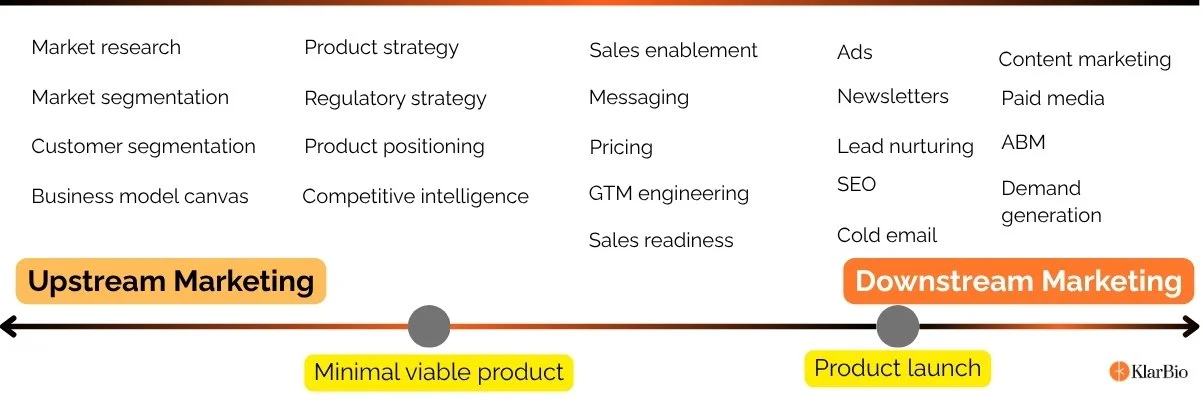
Activities comprising upstream and downstream marketing and where they may take place in the product lifecycle. Source: The Product Marketing Playbook for B2B Life Science.
Example: I worked with a marketing team that was adamant about their booth design at events. Each conference was hectic. The marketing and sales teams fought over how to design and lay out the booth. The sales team (comprised of mostly PhDs), kept saying that conference attendees were not interested in the generic messaging currently on display. I suggested we show pictures of the actual product and add some text. The marketing team thought it would look like an academic poster, negatively affecting brand perception.
I told them that the purpose of the branding isn’t to win an art competition. It is to be known and if your branding is boring, you will not be known. The current branding was boring and looked and sounded like other companies.
So we added some product photos and text explaining the images. The sales team at the next event told me that it made a noticeable difference and people stopped to look at the booth set up and engaged more with them at the event. This was a 1P marketing team (meaning they only do promotion) that wanted to own creativity without talking to customers.
Challenge #7: Voice of the Customer is Unknown
I worked with a software company where only the R&D team truly knew how customers were using the product and what they cared about. This insight didn’t trickle down into the rest of the company and people had wildly differing views as to what the market wanted.
A new feature was launched and I was asked to lead the marketing efforts for this. But there was immense friction, to the point where I didn’t quite understand why we were even doing this. We didn’t have clarity as to why this was important and I was doing my best to clarify the actual facts.
The situation I’ve witnessed repeatedly
One of your customers has had a fantastic experience, but you and a select few know about it. All that insight is sitting in your heads but those who can act upon it to tell the world don’t know what’s going on. This is perhaps the most pressing challenge I have witnessed first-hand. When marketing teams don’t get briefed on customer insight, why are they expected to deliver messaging that lands, write emails that convert, and post content that engages?
The fix: bring your strategic hires on customer calls. Make sure the marketing team is informed, especially those writing and designing content. Employees become more engaged and provide more value over time,
Challenge #8: Product Usage Data Not Acted Upon
This is not just a marketing problem but also one that affects innovation. Building without insight and shipping without sharing knowledge of customer experience is greatly limiting. This is where the value of product marketing lies—creating value from a clear understanding of customer needs, sometimes referred to as “customer-back” or “customer-centricity.”
Challenge #9: Incomplete Market and Customer Segmentation
You hired a Mckinsey consultant years ago to segment the market and customers but the landscape has changed. You have a gut feeling about it but your commercial team isn’t ready to go without this information. People are guessing.
Is your customer segmentation truly complete? Are the markets you identified actually the markets you are winning in and capable of delivering value in? Life science has niche marketplaces. It could boil down to laboratories with highly specific instruments. You don’t find this information from a Google search.
The fix: Create a working group of your most strategic people and make a decision about this if sales are not where they should be. Don’t be the company selling blindly.
There are also excellent market research firms that interview real buyers.
Challenge #10: Not Seeing Adjacent Markets as Competition
Novel technologies in the biopharmaceutical value chain are often disruptive and therefore create their own unique markets. Sometimes, they have blue ocean potential as they are first-in-class. Since the pharma industry as a whole has a reputation for moving slowly compared to other industries, the inherent challenge is convincing people they have a problem they don’t yet see. Often times, solutions create more problems than they solve, which is why accompanying services and support are a key part of many tech-bio products and can even be a unique value proposition in some cases.
So it’s important to understand what the alternative is, and this is often in an adjacent market and one you don’t see as relevant. But it is if your buyer could go with that solution instead of yours.
The fix: Create competitive battlecards for your sales team to address every single possible alternative that comes up in a conversation with a prospect.
Challenge #11: Founder-Led, or CEO-Led Marketing
Technical founders have a steeper learning curve than a commercial founder who is leading the marketing front. But their time is limited. I spoke to a founder recently who said he is a 1-person marketing team at the company. As a commercial founder and CEO, he is a master of upstream marketing and go-to-market strategy.
But he is limited by the time he has. This is the main challenge with founder-led marketing. The other is understanding what works and what is a waste of time. That’s where an experienced marketer who understands who various marketing instruments work, can explain what to expect from various tactics.
The fix: Audit your activities over the last year. This is the first step I take with companies ready to invest in marketing or those lacking clarity. Not more spend, more ads, more sales reps. Clarity into what’s working.
Challenge #12: Not Seeing the Status Quo As Competition
Your competition is not just another service or product, it’s the old way of working that is just “good enough.” This is where your case studies and product narrative must communicate value. It always should, but being unable to show value does not show people what they are missing.
Trial periods can also help, as once people taste the improvement in their work, they may not want to lose it.
Features: material things about the product that help it do its job
Benefits: the result of these features and how it can improve a specific task or aspect of the customer’s situation
Value: What customers can do more of or less of due to the benefits obtained
See: April Dunford’s book Obviously Awesome, a classic in product positioning (applies mostly to B2B technology firms).
Challenge #13: Not Building Brand Equity
Product marketers and commercial advisors tend to focus on what they can see. But building a brand is beyond what we can see today. And brand equity is very much related to product positioning, because customers may choose a product because of the way a brand makes them feel, not because of the value offered by the product alone.
It takes time, but it starts with this: a mission and vision statement. The best companies in the world spend inordinate amounts of money and effort on keeping these simple and to the point. They are not paragraphs, but rather very iconic and short statements. Align the company around these, and that will shape the brand, strengthening your product and service portfolio in ways that cannot be easily seen.
Conclusion
Marketing isn’t promotion, and marketing teams that only promote lead to many internal struggles and challenges. For smaller companies ready to commercialize, the challenges are starting off with the right mindset: test and iterate repeatedly, and align as you grow and culture changes. Don’t expect immediate returns from promotional activities. Marketing should pave the road to success in the long-run.